



True IT Support in China: How Global1Link Achieved Real Security
“After being in China for almost 12 years, we had finally found true IT support, and more importantly true security.”
Nathaniel Perez, Owner.
— Global1Link, April 2026
# Microsoft 365 China # Microsoft Partner China
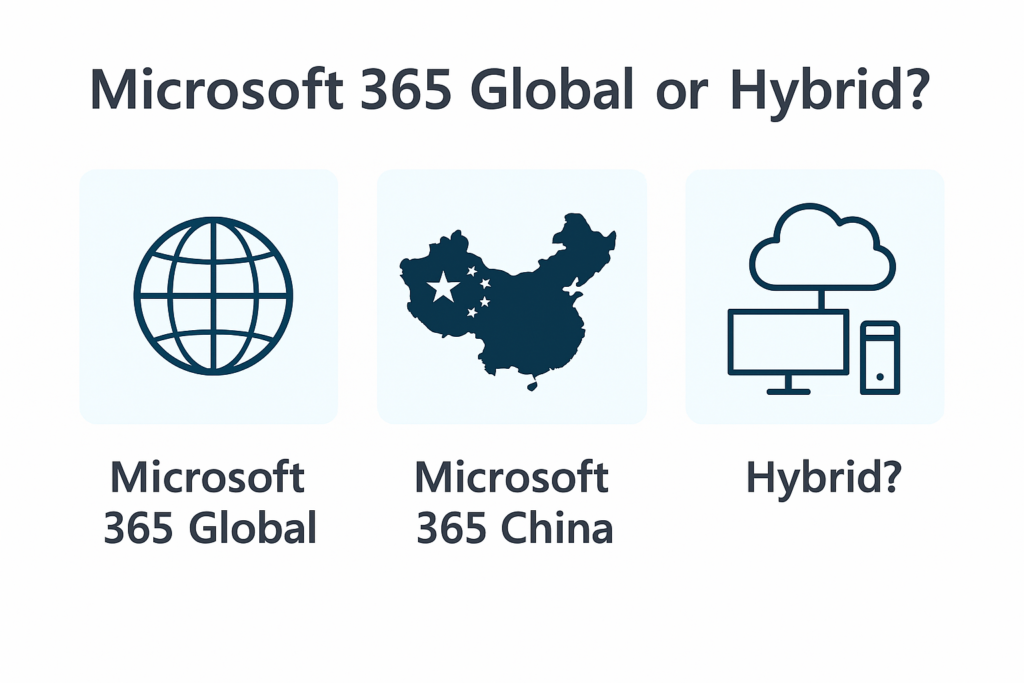
Expanding into mainland China introduces a challenge many organisations don’t expect: Microsoft 365 does not behave the same way in China as it does globally.
For IT leaders, this often becomes clear only after deployment begins — when features are missing, integrations fail, or users cannot access systems the way they normally would.
At this point, the question becomes urgent:
What is different about Microsoft 365 in China — and how do we design it correctly from the start?
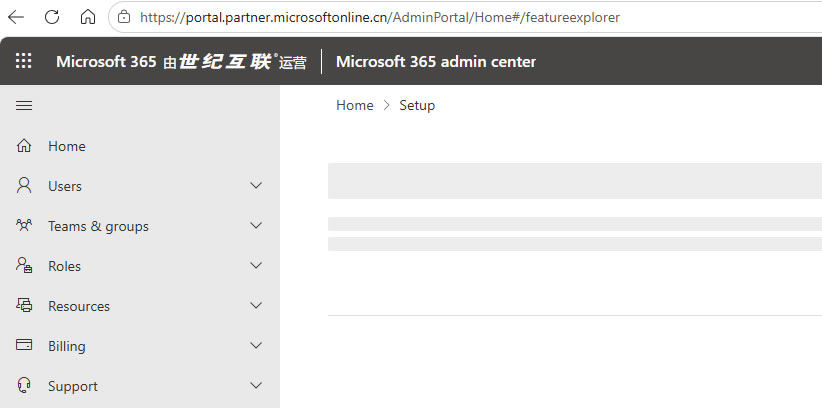
Microsoft 365 in mainland China is operated by 21Vianet, a local partner licensed by Microsoft.
This creates a sovereign cloud environment, not a regional extension of the global platform.
Key differences include:
In practical terms:
Even though the interface looks familiar, you are working with a different platform.
One of the most common challenges appears with authentication. China and global Microsoft 365 environments do not share identity systems.
Microsoft 365 China runs on a separate Entra ID environment.
This means:
Many organisations encounter login failures or integration issues simply because identity boundaries were not considered early.
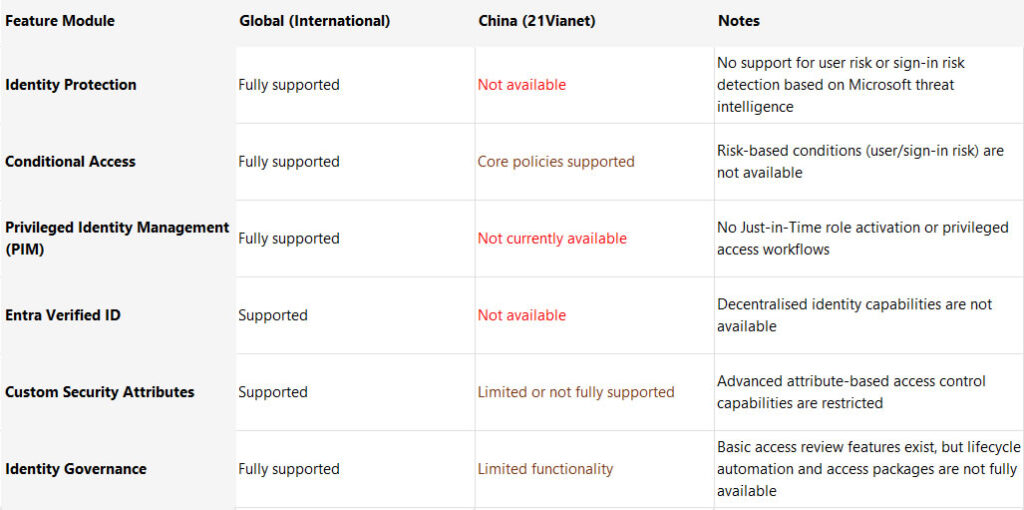
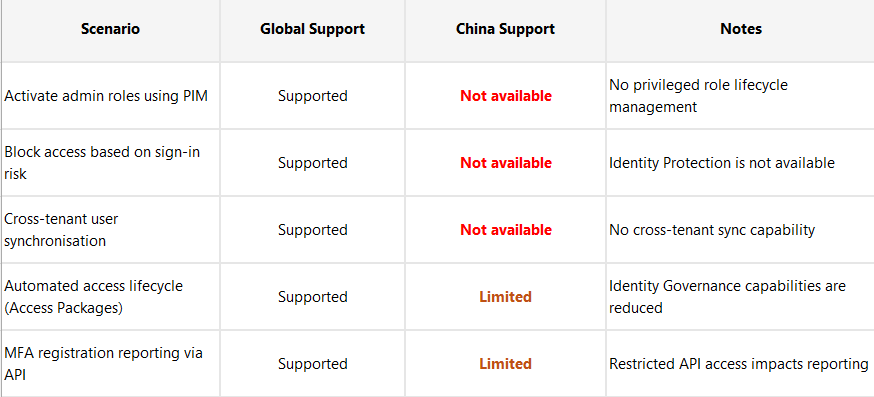
Microsoft 365 operated by 21Vianet follows a different feature set. This impacts planning, especially for organizations expecting full parity with the global cloud.
Examples include:
These are not temporary gaps. They reflect how the China cloud is designed and operated.
Microsoft Intune is available in China, but with important differences:
Application deployment relies on:
This requires adapting deployment strategies. Trying to replicate a global-only setup typically leads to delays and redesign.
Security capabilities exist, but the ecosystem is smaller.
For many organisations, this means introducing additional security solutions within China.
China operates within a distinct network environment, which directly impacts Microsoft 365. Important factors include:
Even with correct configuration file sync may be slower across borders, large data transfers take longer, User experience differs from global tenants.
This is expected behavior, not a configuration issue.
Most global companies don’t choose Microsoft 365 China because they want to. They choose it because of where responsibility must sit.
China has strict rules around where personal and business data lives, who can access it, and how it can cross borders. Over time, these rules have become clearer, more enforced, and harder to ignore. For organizations with staff, customers, or partners in mainland China, data location becomes a governance decision, not just an IT preference.
The organizations operating in China must align with regulatory frameworks such as:
this has direct implications:
This is where Microsoft 365 operated by 21Vianet enters the picture. This is the primary reason the China cloud exists.
All Microsoft 365 data in the China environment is stored within mainland China, and comply with PIPL, DSL, CSL, others.
Most challenges we see come from one assumption:
“Microsoft 365 in China should behave like the global version.”
In reality:
Without designing for these differences early, organizations often face:
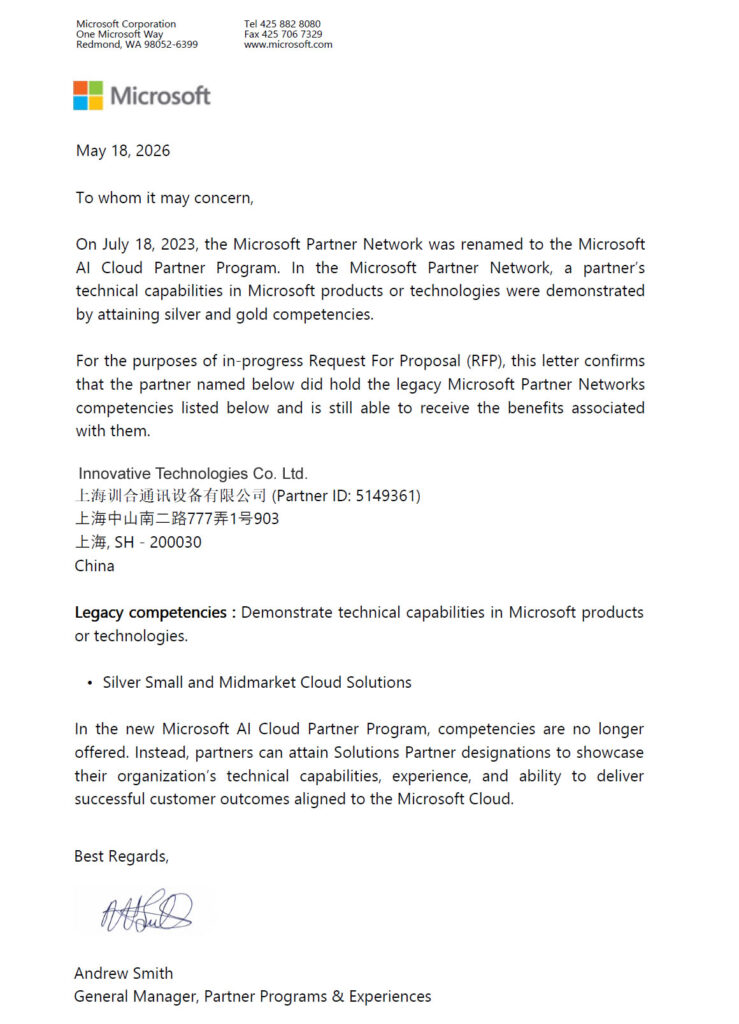
Microsoft partner certification demonstrating expertise in Microsoft 365 China deployment and cloud solutions
Many organizations explore a hybrid approach to balance compliance and usability.
It is technically possible to keep email and collaboration data in the China tenant while managing devices through global Intune and classic Windows Autopilot. This improves device provisioning, policy control, and lifecycle management
“Improving device lifecycle management while retaining China data residency.”
The collaboration and security tools remain limited due to regulatory and architectural boundaries. There is no single configuration that removes these limits without increasing compliance risk.
This model is not prohibited by default, but it is not automatically compliant either. This puts you in a grey zone, not an illegal zone. Device telemetry and management data still flow to the global tenant. From a compliance perspective, this sits in a grey area that usually requires legal review, documentation, and internal approval.
Hybrid is not a shortcut — it is a controlled trade-off.
Successful Microsoft 365 deployments in China start with a different mindset:
Our approach is simple:
Start with the reality of the China platform — then design for success.
Deploying Microsoft 365 in China is not just a technical exercise, it is a design decision. Understanding the hidden risks and real differences early will save time, reduce cost, and prevent compliance issues. Getting this right early avoids costly redesign later.
please help to share this article on

“After being in China for almost 12 years, we had finally found true IT support, and more importantly true security.”
Nathaniel Perez, Owner.
— Global1Link, April 2026

JJA Group shares its long‑standing experience working with INNTECH for responsive managed IT services in Shanghai, highlighting service continuity, flexibility, and long‑term trust since 2015.

InnTech designs and deploys reliable WiFi for Warehouse solutions in China using Cisco Meraki, enabling stable connectivity in high‑ceiling logistics environments and supporting mission‑critical operations for global enterprises.

An official client reference provided by the IT Manager at Pirelli China, confirming that InnTech delivered the overall IT scope for the office relocation to a high standard, with the IT deployment cited as one

As the Chief Operating Officer of SCHMOLL Asia Pacific Ltd., I am pleased to recommend InnTech IT Solutions as a highly reliable and professional Managed Service Provider (MSP) that has consistently met—and exceeded—our IT requirements.