



Microsoft 365 China, Office365 support in China

Microsoft 365 in China: The Real Differences That Matter

# Microsoft 365 China # Microsoft Partner China

Microsoft 365 China: What Global Companies Need to Know Before Deploying

Expanding into mainland China introduces a challenge many organisations don’t expect: Microsoft 365 does not behave the same way in China as it does globally.

For IT leaders, this often becomes clear only after deployment begins — when features are missing, integrations fail, or users cannot access systems the way they normally would.

At this point, the question becomes urgent:

What is different about Microsoft 365 in China — and how do we design it correctly from the start?

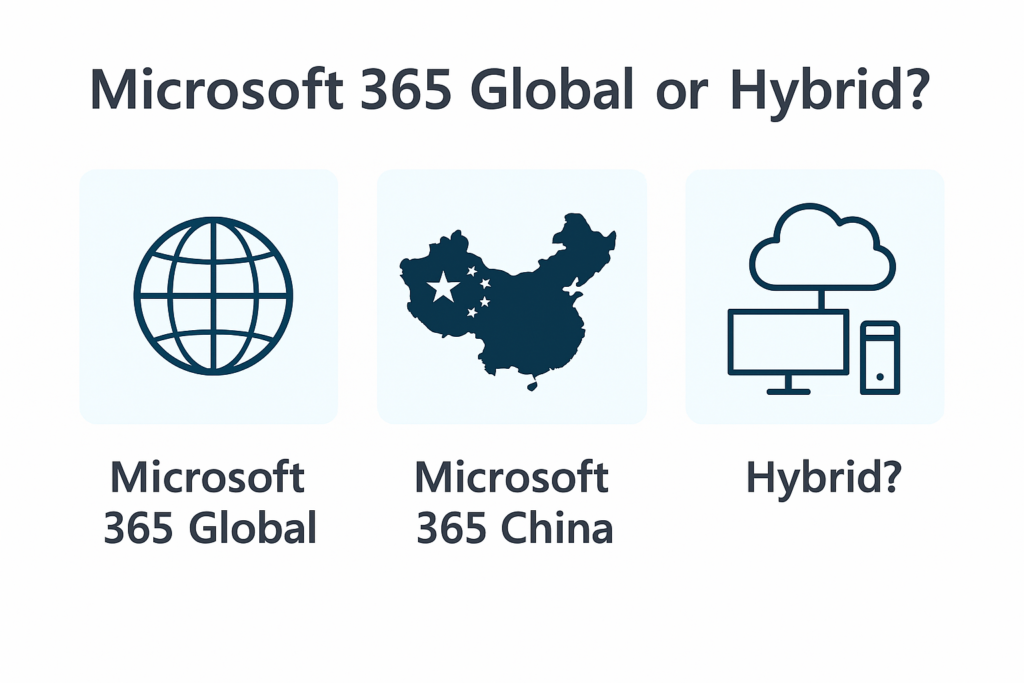
Microsoft 365 China deployment choices highlighting risks between global, China, and hybrid models

Microsoft 365 in China Is a Separate Cloud !

Microsoft 365 in mainland China is operated by 21Vianet, a local partner licensed by Microsoft. 
This creates a sovereign cloud environment, not a regional extension of the global platform.

Key differences include:

  • Dedicated infrastructure located only inside China
  • Separate service endpoints using .cn domains
  • Independent identity platform (Entra ID)
  • Different feature availability and update timelines
  • Localised support and operations model

In practical terms:
Even though the interface looks familiar, you are working with a different platform.

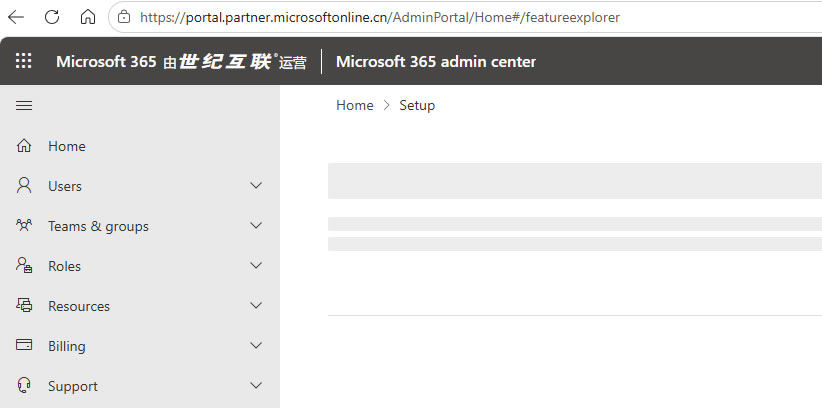
Microsoft 365 China admin center operated by 21Vianet showing similar portal and navigation interface as global Microsoft 365

Microsoft 365 China Identity Differences

One of the most common challenges appears with authentication. China and global Microsoft 365 environments do not share identity systems. 

Microsoft 365 China runs on a separate Entra ID environment.

This means:

  • Users do not exist across China and global tenants
  • Authentication is isolated between environments
  • Access must be explicitly configured

Many organisations encounter login failures or integration issues simply because identity boundaries were not considered early.

Microsoft 365 China Feature Differences.

Microsoft 365 operated by 21Vianet follows a different feature set. This impacts planning, especially for organizations expecting full parity with the global cloud.

Examples include:

Security and Compliance

  • Microsoft Defender for Endpoint → not available
  • Defender for Office 365 → available, but reduced
  • Customer Lockbox → not supported
  • Threat intelligence capabilities → limited
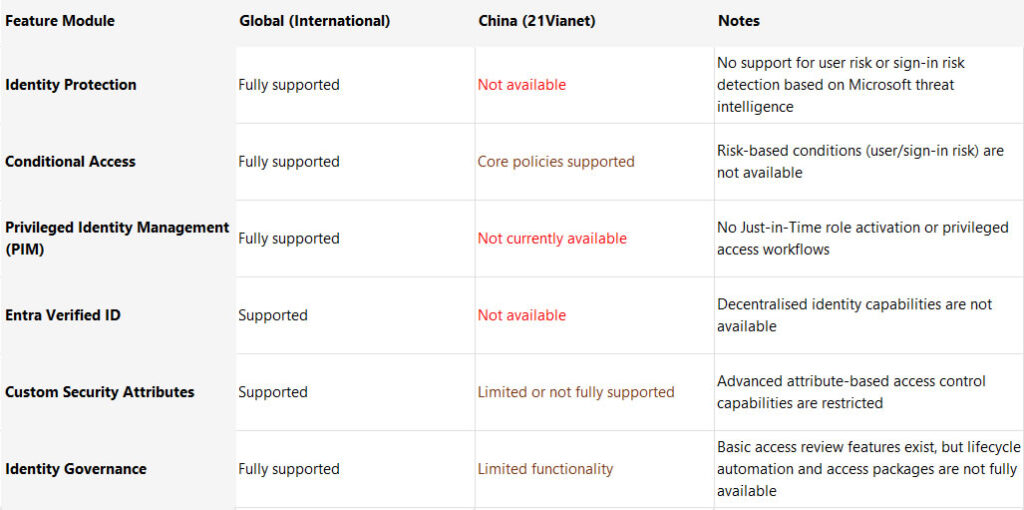
Microsoft 365 China vs global Entra ID comparison table highlighting Identity Protection, Conditional Access and PIM differences

Collaboration

  • Microsoft Teams → functional, but with feature limitations
  • Third-party integrations → often restricted or unsupported
  • Cross-tenant collaboration → requires configuration

Modern Services

  • AI and preview services → often unavailable
  • Some Azure workloads → different or not supported
  • Windows 365 → global-only service.

These are not temporary gaps. They reflect how the China cloud is designed and operated.

Microsoft 365 China Device Management Differences

Microsoft Intune is available in China, but with important differences:

  • Classic Windows Autopilot → not supported
  • Autopilot Device Preparation → recommended approach
  • Microsoft Store for Business → not available

Application deployment relies on:

  • Win32 applications
  • Line-of-business apps
  • WinGet

This requires adapting deployment strategies. Trying to replicate a global-only setup typically leads to delays and redesign.

Microsoft 365 China Security Limitations.

Security capabilities exist, but the ecosystem is smaller.

  • Reduced automation and investigation tools
  • Limited integration across Microsoft security services
  • Greater reliance on manual analysis and logs

For many organisations, this means introducing additional security solutions within China.

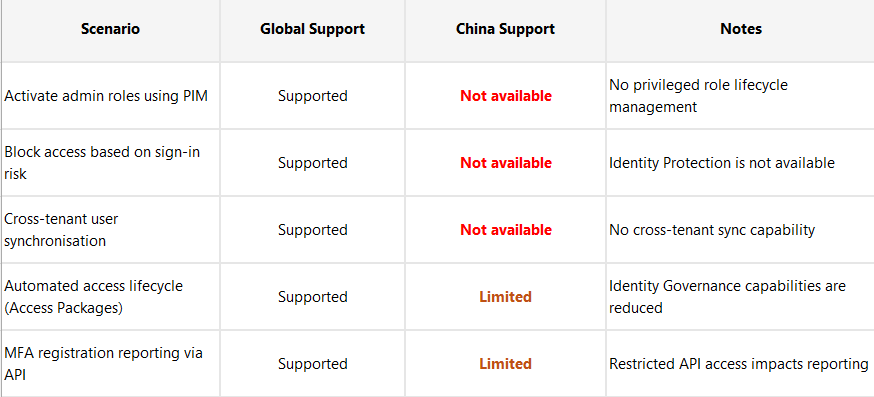
Microsoft 365 China Entra ID limitations showing unsupported features like PIM, sign-in risk policies and cross-tenant sync

Microsoft 365 China Network and Performance Considerations

China operates within a distinct network environment, which directly impacts Microsoft 365. Important factors include:

  • Separate service endpoints and routing
  • Cross-border traffic constraints
  • Latency when accessing global services

Even with correct configuration file sync may be slower across borders, large data transfers take longer, User experience differs from global tenants.

This is expected behavior, not a configuration issue.

Microsoft 365 China Compliance and Data Residency.

Most global companies don’t choose Microsoft 365 China because they want to. They choose it because of where responsibility must sit.

China has strict rules around where personal and business data lives, who can access it, and how it can cross borders. Over time, these rules have become clearer, more enforced, and harder to ignore. For organizations with staff, customers, or partners in mainland China, data location becomes a governance decision, not just an IT preference.

The organizations operating in China must align with regulatory frameworks such as:

  • PIPL (Personal Information Protection Law)
  • DSL (Data Security Law)
  • CSL (Cybersecurity Law) 

this has direct implications:

  • Data location becomes a governance requirement
  • Cross-border data access must be controlled
  • Architecture decisions must consider compliance from day one

This is where Microsoft 365 operated by 21Vianet enters the picture. This is the primary reason the China cloud exists.

All Microsoft 365 data in the China environment is stored within mainland China, and comply with PIPL, DSL, CSL, others.

Microsoft 365 China vs Global: Why Deployments Struggle.

Most challenges we see come from one assumption:

“Microsoft 365 in China should behave like the global version.”

In reality:

  • Identity is separate
  • Feature sets differ
  • Network behavior is unique
  • Compliance requirements are stricter

Without designing for these differences early, organizations often face:

  • Delayed rollouts
  • Unexpected rework
  • Security and compliance gaps
  • User experience issues

Microsoft partner certification demonstrating expertise in Microsoft 365 China deployment and cloud solutions

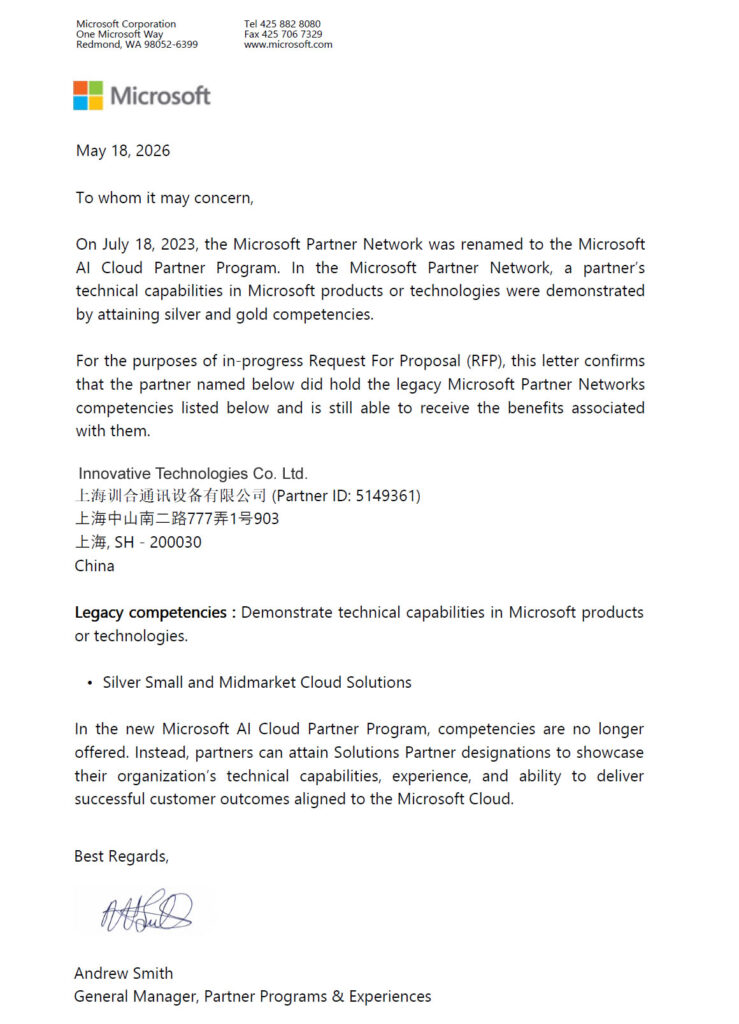
Official Microsoft letter confirming InnTech partner status and cloud solution competencies for Microsoft 365 services in China

Microsoft 365 China Hybrid Deployment (Global + 21Vianet).

Many organizations explore a hybrid approach to balance compliance and usability.
It is technically possible to keep email and collaboration data in the China tenant while managing devices through global Intune and classic Windows Autopilot. This improves device provisioning, policy control, and lifecycle management

What this model looks like

  • Data (email, SharePoint, Teams) → Microsoft 365 China
  • Devices and endpoint management → Global tenant (Intune, Autopilot).

    “Improving device lifecycle management while retaining China data residency.”

The collaboration and security tools remain limited due to regulatory and architectural boundaries. There is no single configuration that removes these limits without increasing compliance risk.

This model is not prohibited by default, but it is not automatically compliant either. This puts you in a grey zone, not an illegal zone.  Device telemetry and management data still flow to the global tenant. From a compliance perspective, this sits in a grey area that usually requires legal review, documentation, and internal approval. 

When hybrid makes sense

  • Multinational organisations with global IT standards
  • Environments requiring advanced endpoint management
  • Scenarios where compliance risk is understood and managed

Hybrid is not a shortcut — it is a controlled trade-off.

Microsoft 365 China Best Practice Approach.

Successful Microsoft 365 deployments in China start with a different mindset:

  • Treat China as a sovereign environment
  • Design identity and access intentionally
  • Plan for feature differences, not parity
  • Align architecture with compliance requirements
Only after fully understanding these differences should organisations consider how to connect China with global environments — including whether a hybrid deployment model is appropriate.
Microsoft 365 China, Office365 support in China

Our Experience Supporting Microsoft 365 in China.

As a Shanghai-based MSP and Microsoft partner, we support global organisations deploying Microsoft 365 in China. We understand both the global Microsoft cloud and the China sovereign cloud—and how to make them work together effectively.

Our experience includes:
  • Microsoft 365 (21Vianet) deployment and operations
  • Cross-tenant identity and access design
  • Compliance-aware architecture planning
  • Integration between China and global environments
  • Ongoing support aligned with both local regulations and global standards

Our approach is simple:
Start with the reality of the China platform — then design for success.

Start with the Right Design.

Deploying Microsoft 365 in China is not just a technical exercise,  it is a design decision.  Understanding the hidden risks and real differences early will save time, reduce cost, and prevent compliance issues. Getting this right early avoids costly redesign later.

please help to share this article on